The best Lovable alternative depends on what Lovable does not give you. If you need a native mobile app for the App Store and Google Play as well as a web app, with the database in your own account and a flat monthly plan, Cadrant fits: native mobile is included from $20 a month. If you read code and want full control, Bolt.new. For an internal tool with nothing to configure, Base44. For a Python backend, Emergent. For a project outside the JavaScript world, Replit. And if your product is a web app and Lovable ships it, staying is a perfectly good answer.
Lovable is one of the best prompt-to-app builders available: you describe an idea and get a working React web app with careful design, a backend and hosting in minutes. People look elsewhere for three structural reasons: no native mobile output, one credit balance that pays for both building and running the app, and a backend that lives on Lovable's platform unless you set up your own Supabase project. Cadrant is our own builder, so we list it first and say so openly; every other tool gets its strengths and its limits. Prices come from each vendor's pricing page or documentation, checked in October 2026.
Lovable alternatives at a glance
Entry paid plans, billed monthly, as of October 2026. Lovable is the last row, for reference.
| Builder | Entry paid plan | Native mobile | Backend | Code export | Best for |
|---|---|---|---|---|---|
| Cadrant | Starter: $20, 300 credits, 5 projects, hosting and custom domain included | Yes (Expo), guided App Store and Google Play publishing | Supabase, in your own account | GitHub and export from Pro ($40) | Web and native mobile from one tool |
| Bolt.new | Pro: $25, from 10 million tokens | Yes (Expo), you run the store builds | Bolt Database, or Supabase on Pro | GitHub sync | Developers who want the files |
| Base44 | Starter: $20, 100 message credits, 2,000 integration credits | No, a wrapper around the web app | Built in, hosted by Base44 | GitHub from Builder ($50) | Internal tools, zero setup |
| Emergent | Standard: $20, 100 credits | Yes (Expo), you run the store builds | FastAPI and MongoDB, on Emergent's cloud | GitHub from Standard | Python-friendly teams |
| Replit Agent | Core: $20, $20 of usage credits | Yes (Expo), App Store first | PostgreSQL, hosted by Replit | Git and GitHub | Any language, scripts, services |
| Lovable | Pro: $25, 100 credits plus 5 daily build credits | No, web apps only | Lovable Cloud by default, or your own Supabase | GitHub on every plan, download on paid plans | Design-led web apps |
Why people look for a Lovable alternative
The three reasons below come from Lovable's own pricing page and documentation. None of them makes Lovable a bad tool; each one rules it out for a specific kind of project.
1. No native mobile app
Lovable generates web applications. Its iOS and Android app is a companion for building on the go, not a way to ship your project as a native app. To reach a phone you can make the web app responsive, install it from the browser as a PWA, or pay a third-party service to wrap it in a native shell. None of these produces a React Native project.
The difference shows on the device and in store review. A wrapped website reaches the camera, push notifications and background tasks less reliably than a native app, iOS restricts it more than Android, and Apple's reviewers reject thin wrappers that add nothing beyond the website. If your roadmap says App Store within six months, a web-only builder means building twice. Our guide to web app, PWA and native app details the trade-offs.
2. One balance for building and running
Pro costs $25 a month ($250 a year) for 100 credits, plus 5 daily build credits that do not roll over. Higher tiers go up to 10,000 credits for $2,250 a month. Build messages cost a variable amount: Lovable's examples range from 0.50 credits for a color change to 1.20 for adding authentication. Unused monthly credits roll over and expire two months after they are issued.
The part that surprises people is the running cost. Lovable Cloud usage (database, storage, hosting, functions) is paid in the same credits. Each plan includes a monthly grant of 20 Cloud credits, which covers small apps; beyond it, the live app draws on the balance you build with, and the backend pauses only when the workspace has no credits left at all. A busy app and a heavy iteration month compete for the same pool.
3. The backend sits on Lovable unless you choose otherwise
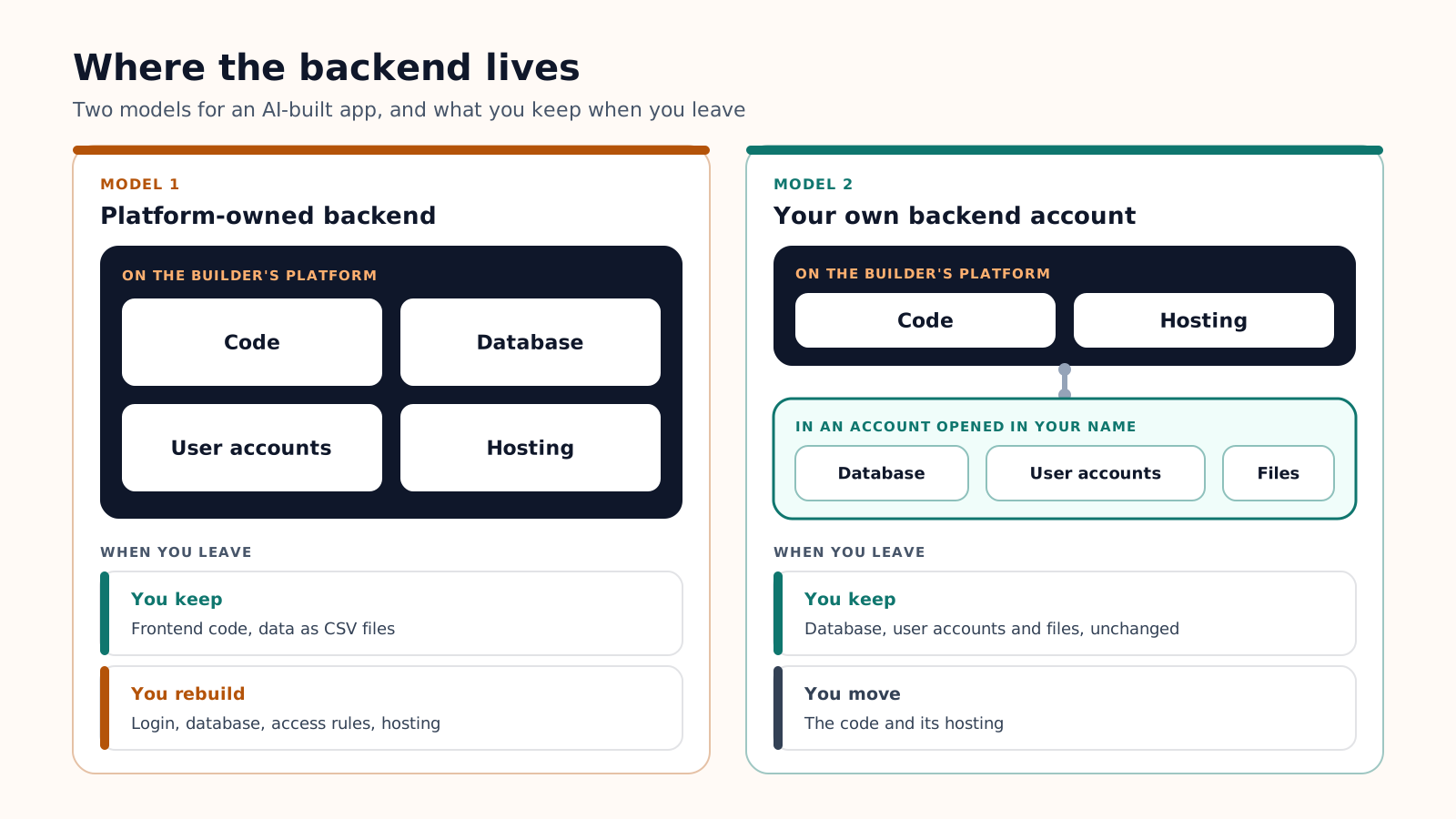
Lovable Cloud is on by default for new projects. It is built on Supabase's open-source foundation and includes the database, authentication, storage, functions and hosting. You can pick your own Supabase project instead when you create a project, but Lovable's Cloud documentation is clear that switching later is manual: export the data, connect Supabase to a new Lovable project and rebuild the schema. The default is the fastest start and the hardest exit.
The 5 Lovable alternatives, one by one
Cadrant: web apps, native mobile and websites in one plan
Cadrant is our builder, so weigh this section accordingly. You describe the project in plain language and it generates React web apps, native mobile apps built with Expo and React Native, or SEO websites; you then iterate by chat or in a visual editor.
Against Lovable, the differences are structural. The mobile app is a real native Expo build, not a website in a frame: you test it on your phone through Expo Go, and Cadrant guides the build on your own Expo account and the submission to App Store Connect and Google Play from your own developer accounts. The backend is Supabase (PostgreSQL, authentication, storage, edge functions) connected to your own Supabase account, so the data is yours from day one. Starter costs $20 a month for 300 credits and up to 5 projects, with hosting and a custom domain included; about 10 credits create or modify an app, and a published app does not draw on your credits.
- Choose it if: your roadmap includes a store app as well as a web app, or you want the database in an account you own.
- Limits: GitHub sync and code export start with Pro ($40 a month, 1,000 credits, unlimited projects), and the free plan is 10 credits at signup, enough to test, not to build a product. The stack is fixed: for Django or an unusual database, an AI IDE fits better.
Bolt.new: a full development environment in the browser
Where Lovable feels like a polished product, Bolt.new from StackBlitz feels like an IDE with an agent driving it: files, a terminal, npm packages and a live preview in the browser. Pro costs $25 a month and starts at 10 million tokens, which roll over for one extra month; hosting and custom domains are included. A database is created automatically, and Pro users can choose Supabase instead. Mobile apps use Expo and preview in Expo Go. The free plan gives 1 million tokens a month, capped at 300,000 a day.
- Choose it if: you read code and want control over structure and dependencies.
- Limits: most tokens go to the agent reading your files, so large projects cost more per message, and store publishing means running Expo's build tools yourself. More in our Bolt.new alternatives guide.
Base44: backend included, nothing to configure
Base44, part of Wix since 2025, goes further than Lovable on the built-in backend: database, login, file storage and hosting are part of the platform, with no option to bring your own. Starter costs $20 a month ($16 billed yearly) for 100 message credits and 2,000 integration credits, which the live app spends when it sends emails, stores files or calls AI. GitHub sync starts with Builder at $50 a month. The free plan gives 25 message credits a month.
- Choose it if: you want an internal tool running today without creating a single external account.
- Limits: web apps only, with a native wrapper for the stores, and the database stays on Base44's infrastructure when you leave. See our Base44 alternatives.
Emergent: multi-agent builds with a Python backend
Emergent orchestrates agents for planning, front end, back end, testing and deployment. Its stack stands out: React (Expo for mobile) on the front, FastAPI and MongoDB on the back. Standard costs $20 a month ($17 billed yearly) for 100 credits, Pro $200 for 750, and the free plan gives 10 credits a month. Each deployed app costs from 50 credits a month, half of Standard's allowance.
- Choose it if: your team works in Python and you want testing and deployment handled by the same pipeline.
- Limits: the hosting cost per live app, and store publishing through Expo's command line. Details in our Emergent alternatives comparison.
Replit Agent: any language, usage billing
Replit is a cloud development workspace with an agent on top: editor, packages, databases, deployments and collaboration in one place. Core costs $20 a month ($18 billed yearly) and includes $20 of credits that pay for the agent, publishing and database usage. It is the most polyglot option here, and it builds mobile apps with Expo. The free Starter plan allows one published app, taken down after 30 days.
- Choose it if: the project is a Python service, an automation or anything outside a standard React app.
- Limits: past the included credits you pay as you go, so the bill moves with activity, and interfaces are less polished than Lovable's out of the box.
Not like-for-like: AI IDEs and classic no-code
Many lists add Cursor, Windsurf, v0, Bubble or Glide. AI IDEs such as Cursor work inside a codebase you already have and assume someone reviews the diffs; see AI app builder vs AI IDE. v0 generates React and Next.js front ends but not native mobile apps. Bubble and Glide are visual editors whose apps run inside their platform. All are useful; none replaces Lovable for the same job.
How to choose your Lovable alternative
Decide on what is expensive to change later, in this order:
- Scope. Web only, or also a native app in the stores? This is the one choice you cannot fix without rebuilding.
- Backend ownership. A database in an account opened in your name, or one that lives on the vendor's platform.
- Cost once live. Is hosting part of the plan, or does the running app draw on the credits you build with?
- Code export. GitHub sync or download, and from which plan.
- Stack. Whether the next developer you hire already knows it.
Moving a project off Lovable
Switching builder is closer to a rebuild than a move. Push the code to GitHub first (available on every Lovable plan): the React front end is a useful reference for the next tool. If the project uses Lovable Cloud, export the data while your plan is active, because the database does not follow you automatically. A project on your own Supabase is easier: the database and users stay where they are. The domain is a DNS change; the conversation history and remaining credits stay behind.
Common mistakes
- Switching on headline price, then meeting the same limit elsewhere: web only, or a running app billed from the build budget.
- Treating a webview wrapper as a native app. Store reviewers and users both notice.
- Ignoring who owns the database. A managed backend is faster on day one and harder to leave on day three hundred.
- Migrating a working app for a marginal gain.
Price is the easiest axis to correct later; scope and backend ownership are not. For budgets across builders, see our AI app cost breakdown, and for the wider market, our comparison of the best AI app builders.