Before walking into a spa or a treatment room, most people hesitate. They do not know what the cabin looks like, how long the treatment really takes, whether they need to bring anything, or what the final price will be. That hesitation almost always happens on a phone screen, minutes before the decision. A good wellness website exists to remove those doubts one by one: show the space as it truly is, explain what happens during a session, publish the prices and let someone book in two taps. This guide covers the pages to build, the booking features that matter, local search visibility, and the care you need to take with health claims and personal data.

Why a wellness website still matters when you already use booking platforms?
According to the BrightLocal Local Consumer Review Survey 2026, 97% of consumers read online reviews and 31% only use businesses rated 4.5 stars or higher. Third-party beauty and wellness marketplaces bring a real flow of new customers, and there is no reason to refuse that when you are starting out. But they come with three lasting constraints. First, a commission on every booking, including regulars who would have come back anyway. Second, complete dependency: ranking, visibility and cancellation rules are set by someone else, and a single change to their algorithm can empty your diary. Third, and most expensive over time, you do not own the customer relationship. You have no email list, no treatment history, and no freedom to contact the people who have already visited you.
A site you own reverses that balance. It becomes the natural destination for searches on your business name, for your window display, your business cards and your social posts. The sensible strategy is not to abandon the platforms overnight, but to gradually move loyal clients towards direct booking, where the margin stays intact and you control the whole experience.
- No commission on direct bookings, which immediately improves the profitability of every treatment room.
- Ownership of client data: emails, treatment preferences and history, handled with proper consent.
- Full editorial freedom to present your atmosphere, your products and your protocols.
- A long-term asset that grows in value as your organic search visibility builds.
What visitors want to know before they book?
Most sites in this sector talk about philosophy and harmony while the visitor is looking for very concrete facts. Before booking a treatment, someone wants to know who will look after them, exactly what happens during the session, how much time to block out, what it costs, where the place is and how to park nearby. If any of those answers is missing, they close the tab and look elsewhere.
- Who you are: therapists and practitioners, training completed, techniques used, years of experience.
- The exact sequence: welcome, short consultation, actual treatment time, shower, relaxation area.
- The real duration including preparation, not only the hands-on part of the massage.
- Prices stated without ambiguity, including supplements and course packages.
- The location: address, transport links, parking, floor level, lift access.
- How to book, cancel or move an appointment.
One underestimated detail is the set of practical and slightly awkward questions. Do I need to undress completely? Are towels provided? Is the sauna mixed? Can I book a treatment during pregnancy? Answering these openly on the site removes genuine embarrassment and noticeably increases the number of bookings.
The page structure of an effective wellness website
Home page
It must answer three questions within five seconds: what kind of place this is, which town or neighbourhood it serves, and how to book. A real photograph of your treatment room or relaxation area is worth far more than a stock image seen on a hundred other sites. Put the booking button above the fold, and repeat your opening hours and a tappable phone number.
One page per treatment
This is the backbone of both search visibility and conversion. Build a dedicated page for each major service: back massage, facial treatment, body scrub and wrap, sauna and steam room access, couples ritual. Each page describes the experience, the duration, the sequence, any contraindications, the price and a booking button. A single page listing ten treatments ranks for nothing; ten focused pages capture ten different families of searches.
What happens during a session?
A cross-cutting page that walks through a visit from arrival to departure removes the anxiety of people who have never set foot in a salon. Say what you provide, describe the changing area, the robe, and whether they can stay in the relaxation space afterwards.
Prices
One clear, up-to-date page, readable on a phone, listing single treatments, courses and gift cards. Visitors actively search for this page: hiding it loses more customers than it protects.
About and professional background
Introduce the team with genuine photographs, qualifications, the cosmetic brands you work with and the thinking behind the place. In a hands-on profession, knowing who will be treating you matters as much as the price.
Reviews
Collect authentic testimonials and, where possible, attach them to the specific treatment. A detailed comment about a facial is far more persuasive than a general compliment about the welcome.
Booking and contact
Bring together the booking widget, an enquiry form, the phone number, an email address and your real opening hours, including holiday closures and exceptional changes.
Getting there
A map, transport links, nearby car parks and step-free access details. In London or Manchester, parking difficulty is a very concrete reason people give up on a booking.
Online booking, the heart of the system
Online booking is no longer a nice extra but a basic expectation. A large share of enquiries arrive in the evening and at weekends, when nobody is answering the phone. A calendar that is always open captures intent that would otherwise be lost.
Slots, deposits and cancellations
Show real availability, synchronised with each room and each practitioner, so that double bookings cannot happen. For long treatments and couples rituals, a deposit sharply reduces no-shows. State your cancellation policy in plain words: the notice required, and whether the deposit is refunded or moved. A clear rule is accepted far more easily than a vague one applied case by case.
Reminders and no-shows
An automatic reminder by email or text the day before is one of the most profitable measures a salon can put in place. Add a one-click rescheduling link too: a client who moves an appointment is still a client, whereas a client who simply does not turn up leaves an empty room and an hour of lost work.
Prices, courses, taster packages and gift cards
Price transparency is a sales argument, not an admission of weakness. Publish single-treatment prices, then build a logical progression towards longer commitments. A short taster package lets someone try a treatment without feeling tied in; a card of five or ten sessions builds loyalty and secures revenue in advance; a monthly membership covering sauna and steam room access smooths out quiet weekday hours.
Gift cards deserve their own page and their own attention. For many salons they represent a meaningful share of annual revenue, concentrated around the festive season. Allow online purchase, instant digital delivery, and a choice between a free amount and a specific treatment. Think about seasonal offers as well: skin preparation before summer, warming rituals in winter, campaigns around Mother's Day. These moments justify a temporary landing page and a targeted message to your existing client list.
Local SEO: being found in your town and neighbourhood
A salon does not compete on national queries but within a radius of a few kilometres. The first building block is your Google Business Profile: exact category, accurate opening hours, recent photographs, a service list and a link to your site. It feeds the map results that capture a large share of mobile clicks.
The second building block is NAP consistency. Your name, address and phone number must be strictly identical on your site, your Google profile, directories and social accounts. An address written three different ways blurs the signal you send to search engines.
- Create a page per town or district if you serve several areas, with genuinely different content each time.
- Target long-tail intent: back massage near London Bridge, salon open Saturday evening, facial for sensitive skin.
- Ask for reviews shortly after the treatment, with a direct link to your profile.
- Reply to every review, including negative ones, never mentioning any health information about the person.
- Add LocalBusiness structured data in JSON-LD with your address, hours, service area and price range.
Performance, mobile experience and accessibility
Most traffic to a wellness website comes from phones, often on the move and on an average connection. Design should therefore start from mobile: a call button within thumb reach, a short form, text readable without zooming, a booking widget usable with one hand. Core Web Vitals affect both ranking and abandonment, and this sector nearly always fails in the same place: beautiful photographs that are far too heavy.
- Export images in a modern compressed format, sized for how they are actually displayed.
- Lazy-load images below the fold and reserve their space to avoid layout shifts.
- Go easy on autoplay atmosphere videos, which are very expensive in data.
- Take accessibility seriously: sufficient contrast, alt text, keyboard navigation, a proper heading hierarchy.
- Link pages together: a treatment page points to the matching course, the price page points to booking.
Being visible in AI answer engines
More and more people phrase their search as a full question and read a synthesised answer rather than a list of links. To be quoted in those answers, a site has to be factual and well structured. The pages that perform best answer a question explicitly, in plain language, with verifiable details that stay consistent from one page to the next.
- Write short FAQ entries where each question is followed by a complete, self-contained answer.
- Always repeat the same business facts: name, address, hours, services, prices.
- Avoid vague wording and unverifiable promises, which these systems handle poorly.
- Keep price and opening-hour pages current, because outdated information circulates for a long time.
Claims, careful wording and data protection
Separating wellbeing from medical treatment
This is the most important point of caution in the sector. A relaxing massage, a body scrub or a sauna session belong to comfort and relaxation, not to medical care. Never promise a cure, never announce that a pain or a condition will disappear, and never guarantee centimetres lost. Write in terms of how people feel and how you support them: a sense of relaxation, release of tension, a moment of recovery. Mention the usual contraindications and explicitly invite anyone concerned to seek advice from a healthcare professional, particularly during pregnancy, with circulatory conditions or while under treatment. This caution protects you legally and inspires more trust than an exaggerated pitch.
Privacy and personal data
Booking forms sometimes collect very personal information: allergies, pregnancy, sensitive areas, ongoing treatment. That data deserves particular care. Apply data minimisation by asking only for what you genuinely need to deliver the service, and ask sensitive questions in the treatment room rather than in a public form. Publish a clear privacy notice, use separate consent for marketing emails, choose serious hosting, define a retention period and offer a simple deletion process on request. Client notes should never travel through unsecured messaging.
If your salon also offers more intimate accompaniment sessions, sophrology, hypnotherapy or naturopathy, the wording needs to be even more careful. Our guide on the therapist website covers the professional boundaries specific to those practices and the phrasing to avoid entirely.
Measuring what actually matters
Visit counts tell you almost nothing. The useful indicators are the ones connected to your diary: online bookings, calls triggered from the site, gift card sales, occupancy rate per day and per room, and how full those quiet Tuesday and Thursday slots are. Track the split between direct bookings and platform bookings too, because that shift is what improves your margin. Google Search Console completes the picture by showing the real queries bringing traffic; they often reveal treatments you offer without promoting, or questions your pages do not yet answer.
Building a wellness website with Cadrant, without coding
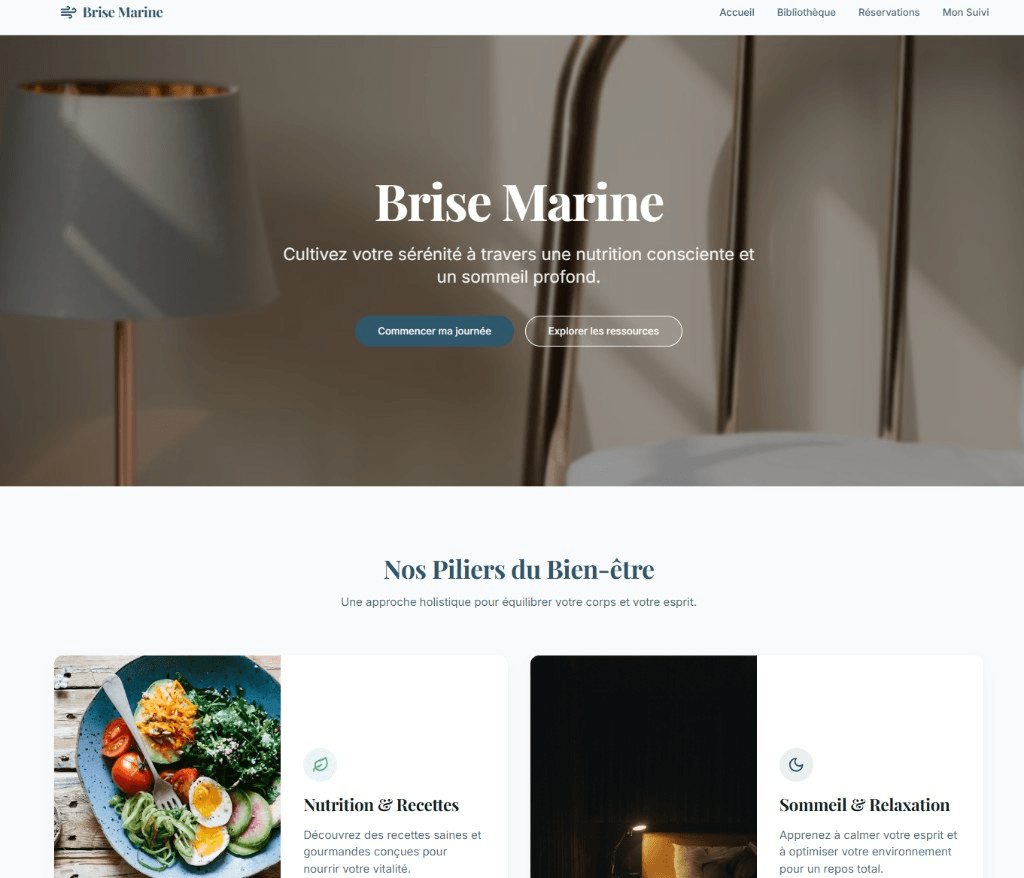
Many salon owners postpone this project for lack of time or technical budget. With Cadrant, you describe your business in plain language, list your treatments, prices and how booking works, and the platform generates a structured site that you then refine through conversation. You can create a page per treatment, adjust prices by season, add a gift card page before the holidays or change your opening hours without depending on an outside supplier.
- A complete page structure generated from your description, including individual treatment pages.
- Immediate adaptation of the visual theme to your identity and the atmosphere of the space.
- Search best practice built in from the start: titles, meta descriptions, structured data.
- Independent updates to prices, hours and seasonal offers.
An effective wellness website is not spectacular: it answers real questions, shows the place as it is, publishes prices, lets someone book in three taps and loads quickly on a phone. Start with the home page, the booking flow and two flagship treatment pages, publish, then add one new treatment or one frequently asked question every month. That regularity, far more than a perfect redesign postponed year after year, is what fills a calendar.