Someone looking for support usually hesitates for a long time before picking up the phone. They wonder who they will be speaking to, whether they will be judged, what actually happens in a session, how much it costs and whether they can stop whenever they want. That hesitation almost always plays out online, late in the evening, on a phone. A well-built therapist website exists precisely for this: to put a face and a framework around something personal, explain your approach without jargon, set out the practical conditions and make booking straightforward. This guide covers the pages you need, appointment handling, local search visibility, data protection and, above all, the care your wording requires.

Why a therapist website still matters alongside directories and platforms?
According to Google, 46% of searches have local intent, and the BrightLocal Local Consumer Review Survey 2026 reveals that 97% of consumers read online reviews before choosing a provider. Practitioner directories and booking platforms give immediate visibility, which is genuinely useful when you are starting out. But they have three structural limits. The first is financial: a monthly subscription or a fee per session, including for people who already knew you. The second is dependency: your position depends on a ranking you do not control, and you appear among dozens of colleagues in a standardised format that flattens exactly what makes you different. The third is the relationship: you have no contact list of your own and no space to explain your method in depth.
A site you own fixes all three. It becomes the reference point when someone searches your name after a recommendation, which happens constantly in this field, where word of mouth remains the main channel. It also lets you write at length about how you work, which no directory listing allows. The sensible approach is to keep one or two directories for discovery and make your own site the destination for everything else you do.
- No commission on appointments booked directly with you.
- Unlimited space to explain your method, your background and the way you work.
- More credibility when someone searches your name after being referred by a friend.
- A durable asset whose visibility grows over time through organic search.
What visitors want to know before they book?
People looking for a practitioner are above all trying to reassure themselves. They do not always know the difference between hypnotherapy, counselling and reflexology, and they rarely dare to ask their real questions on the phone. Your site therefore has to answer, in plain words and in advance, the concerns that stop people from making contact.
- Who you are: your background, your training, any professional memberships, how you work.
- What happens during a session: the welcome, the initial conversation, the exercises, the role of talking, the body or silence.
- How long a session lasts and the usual rhythm of ongoing support.
- Your fee, accepted payment methods and your cancellation policy.
- The location: address, floor, accessibility and whether remote sessions are possible.
- The concrete steps for booking a first appointment.
One question comes up constantly without ever being asked out loud: how many sessions will this take? You cannot answer that precisely, and it would be unwise to try, but you can honestly explain how a typical course of support unfolds, how often people usually come back, and remind readers that they are free to stop at any point. That honesty reassures far more than an invented number.
The page structure of an effective therapist website
Home page
It must say within five seconds who you are, what you practise, in which town, and how to reach you. A professional photograph of you and of your consulting room has a measurable effect: the visitor can picture the chair they will sit in. Put the booking button at the top of the page and repeat a tappable phone number.
One page per practice or type of support
If you offer several approaches, give each its own page: hypnotherapy, breathing and relaxation work, reflexology, naturopathy consultations. Describe what the practice is, how it unfolds with you, who it may suit and who it does not suit, the duration and the fee. A single page stacking every approach ranks for no specific query and blurs your positioning in the reader's mind.
What happens in a session?
This is often the most-read page on a practitioner's site. Walk through a first session from beginning to end: the initial conversation, the questions you ask, what the person may choose not to share, the practical part, the closing and how you agree on next steps. Mention what to wear, that nothing needs preparing and that nothing is imposed.
Fees
State the price of a session clearly, along with its duration, any reduced rates and how payment works. Say whether you can provide a receipt. Hiding your fees loses the people who will never dare call to ask.
About and professional training
Set out your initial training, further courses, the school or organisation that trained you, your years of practice, any supervision arrangements and your professional memberships. Stay strictly factual: only list qualifications you can evidence.
Reviews and testimonials
Testimonials are delicate in this field because they touch on private life. Always obtain written consent, anonymise thoroughly, stay with the general experience of being supported rather than specific outcomes, and never refer to an identifiable health situation.
Booking and contact
Bring together the online diary, a plain form, your phone number and your hours. Give a realistic response time and state clearly that this channel is not suitable for urgent situations.
Getting there
A map, transport links, parking, the floor, whether there is a lift, and what the waiting area is like. In London or Manchester, an anxious person appreciates knowing in advance that they will not have to ring a bell in front of several strangers.
Online booking: removing the barrier of the first phone call
For many people, phoning to talk about something personal is a real obstacle. Online booking removes that step and captures enquiries that arise in the evening or at weekends, outside your consulting hours.
Slots, deposits and cancellations
Publish genuine availability, synchronised with your own calendar, keeping a buffer between consultations. For first appointments, a deposit noticeably reduces lost slots, provided it is announced clearly and refunded according to written rules. Word your cancellation policy kindly but unambiguously: a notice period, a consequence, and a stated exception for serious unforeseen events.
Reminders, video sessions and no-shows
An automatic reminder the day before clearly reduces absences, which are costly in a practice where every slot is unique. If you offer remote sessions, explain how they work, which tool you use, which practices suit them and which require being in the room. Set out the minimum technical conditions too, and the fact that the person needs a quiet, private space.
Fees, packages and the question of reimbursement
Fee transparency is a mark of professionalism. Publish the price per session and the matching duration, and avoid vague phrases such as fees on request. If you offer support across several sessions, present it as a working framework rather than a binding commitment: the person must be able to stop without penalty. Some practitioners offer a reduced rate for students or people in financial difficulty; if that is your case, simply say so.
Reimbursement requires real caution, because rules vary by country, by practice and by insurer. Never state that a session is covered. Say instead that some health insurance policies sometimes contribute towards certain practices, and invite the person to check directly with their provider. Be specific about what you actually supply, for example a named receipt, without promising anything about the outcome of their claim.
Local SEO: being found by people near your practice
A practitioner works within a limited radius, except for remote sessions, so local search is the bulk of your visibility. Create and complete your Google Business Profile with the category matching your practice, your hours, real photographs of the room and a link to your site. That profile feeds the map results which capture a large share of mobile searches.
Then watch NAP consistency: name, address and phone number strictly identical on your site, your Google profile, professional directories and your social accounts. An address written differently from one place to another weakens the signal you send to search engines.
- Create a page per town or district if you work from several rooms, with genuinely different content.
- Work the long tail of intent: hypnotherapist near London Bridge, evening sessions, practitioner available on Saturdays.
- Ask for reviews tactfully, without ever pressing or offering anything in return.
- Reply to reviews neutrally, never confirming or denying that a specific person came to see you.
- Add LocalBusiness structured data in JSON-LD with your address, hours and service area.
Technical performance, mobile and accessibility
Most visits come from a phone, often in the evening. Design should therefore start from mobile: a call button within thumb reach, a short form, text readable without zooming, a diary usable with one hand. Core Web Vitals affect both ranking and abandonment, and practitioner sites usually fail through heavy atmospheric images and through directory or widget scripts that slow everything down.
- Export photographs in a modern compressed format, at the size they are actually displayed.
- Lazy-load everything below the fold and reserve image space to avoid layout shifts.
- Limit third-party widgets, which are heavy and often raise privacy questions.
- Take accessibility seriously: contrast, alt text, keyboard navigation, a consistent heading hierarchy.
- Link your pages: every practice page points to the session walkthrough and to booking.
Being visible in AI answer engines
More and more searches take the form of a full question, and the answer displayed is a written summary rather than a list of links. To appear in those answers, a site has to be factual, consistent and structured. That happens to align with good ethical practice in this field: the more precise and measured your wording, the better it is used.
- Write short FAQ entries, each followed by a complete, self-contained answer.
- Keep practitioner details identical everywhere: name, description of practice, address, hours, fees.
- Avoid vague wording, promises and medical vocabulary if you are not a healthcare professional.
- Keep fee and opening-hour pages current, because outdated information circulates for a long time.
Professional framework, titles and claims
Protected titles and describing your training
This is the most sensitive part of any practitioner site. Rules vary considerably from one country to another: some professional titles are legally protected and their use requires a specific qualification or registration with a competent authority, while other practices are unregulated and covered only by voluntary registers. Before choosing the wording that will appear in your site title, check the framework that applies where you work, and if necessary ask your professional body. When in doubt, describe your practice rather than claim a title: hypnotherapy practitioner, relaxation and breathing coach, naturopathy consultations. Never imply that you are a healthcare professional if you are not.
Never promise a cure or a result
No page on your site should state that a practice heals, cures or treats an illness, nor guarantee a result, nor quote a success rate. Frame everything in terms of process, support and experience: working on stress management, learning breathing exercises, taking time for yourself. Carefully avoid lists of conditions presented as indications. Add a clear notice, visible on your practice pages, stating that your support does not replace medical advice, a diagnosis or ongoing treatment, and explicitly invite people to consult a healthcare professional when their situation calls for it. This caution is not only legal protection: it inspires more trust than an enthusiastic but vague pitch.
Confidentiality and data protection
The data you handle is among the most sensitive there is: reasons for consulting, personal circumstances, session notes. Your website is the first place where that rigour should be visible. Reduce contact-form fields to the strict minimum: a first name, a way to call back, perhaps one free-text line, and definitely no field inviting someone to describe a personal situation. Add a sentence explaining why you do not ask for those details online, which is in itself a signal of seriousness.
- Publish a clear privacy notice: data collected, purpose, retention period, individual rights.
- Collect separate consent for any later communication, never pre-ticked.
- Choose serious hosting and an encrypted form, and avoid free tools whose data handling you do not understand.
- Never store session notes in the same environment as your public website.
- Never confirm publicly, including in a review reply, that someone is or was a client.
Measuring what actually matters
Visitor numbers matter very little. Track the indicators tied to your real activity instead: appointments booked online, calls triggered from the site, forms submitted, the share of first appointments that turn into ongoing support, your weekly occupancy and the proportion of remote sessions. Google Search Console shows the real questions bringing traffic; they often reveal subjects you deal with in the room but have never written about. A page added in answer to a frequent question is almost always more profitable than a visual redesign.
Building your therapist website with Cadrant, without coding
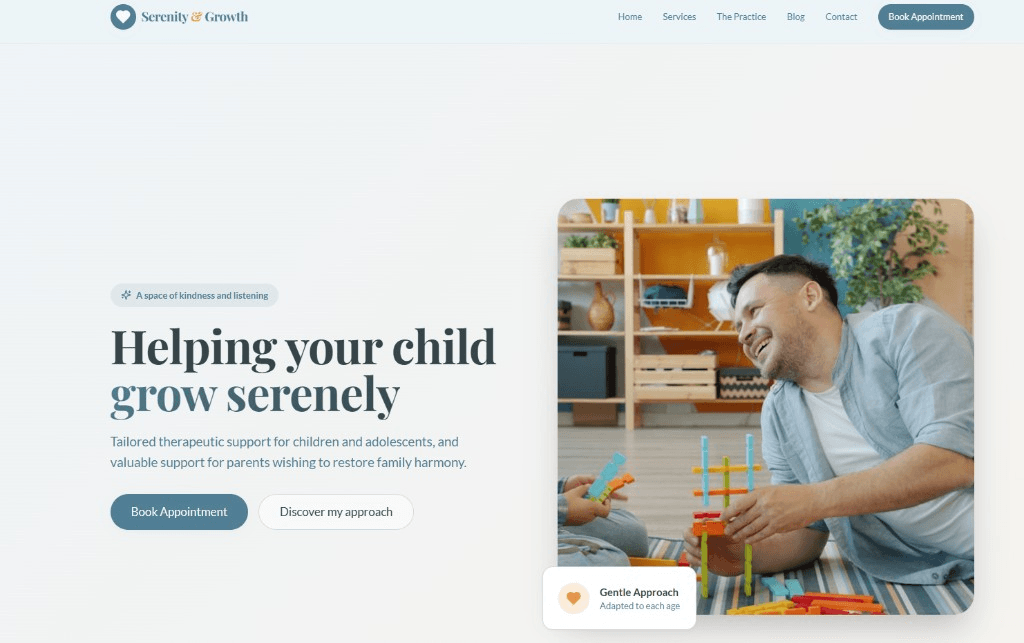
Many practitioners postpone this project because they have neither the time nor the appetite for a technical task. With Cadrant you describe your practice, your pages, your fees and your booking arrangement in plain language, and the platform produces a structured site that you then refine through conversation. You stay independent: add a page when you train in a new approach, adjust your fees or change your hours yourself.
- A complete page structure generated from your description, including one page per practice.
- A restrained visual result consistent with the seriousness expected in this field.
- Search best practice built in from the start: titles, meta descriptions, structured data.
- Independent updates, with no need to call a supplier to change a single line of your fee list.
An effective therapist website is above all an honest one: it explains who you are, what happens in a session, what it costs and how to book, without promising anything. Start with four solid pages, the home page, one practice page, the session walkthrough and contact, publish, then add one answer a month to a question your clients genuinely ask. That regularity builds lasting visibility and, more importantly, the trust someone needs before walking through your door.