Building an MVP (Minimum Viable Product) remains the most critical step in a startup's life. The goal isn't to ship a perfect product, it's to validate a hypothesis as quickly as possible with minimal resources. Too many founders confuse an MVP with a full beta release, which leads to months of development before any user feedback. This guide walks you through the whole path: from the raw idea to a tested MVP, then from a validated MVP to a real SaaS launched with paying customers.
What makes a good MVP and why it matters?
A good MVP is the smallest experiment that lets you test your value proposition with real users. It's not a throwaway prototype or a clickable Figma mockup, it's a functional product, however minimal, that generates actionable data. A successful MVP answers one core question: 'Will someone pay for (or regularly use) this solution?' If you can't articulate that question clearly, you're not ready to build yet.
Lean methodology in practice
Eric Ries' Build-Measure-Learn cycle gains real power when your building tool is fast. With an AI app builder, you describe your idea in natural language and get a working application in hours instead of weeks. This drastically reduces the cost of each iteration. The objective is to maximize the number of learning loops before exhausting your initial budget.
The iterative cycle in practice
- Hypothesis: formulate a testable assertion (e.g., 'Freelance designers want an invoicing tool built into their portfolio').
- Build: create the minimal flow, a form, a results page, a call-to-action button.
- Measure: integrate basic tracking (clicks, signups, time on page) for quantitative data.
- Learn: analyze results after 48–72 hours and decide: pivot, persevere, or dig deeper.
Landing page + waitlist strategy: your first test
Before coding a single feature, a well-crafted landing page is your best ally. Build a page that presents your value proposition, a product visual (even conceptual), and an email capture form. The conversion rate of that page (visitors → signups) is your first validation signal. Aim for at least 5–10% to consider interest genuine. Paired with a minimal ad spend ($50–100 on Google or LinkedIn), you get actionable data within days, without having written a single line of business logic. Go further with pre-sales: offer early access at a discounted price. Nothing validates an idea better than an actual payment, even a symbolic one.
Key elements of an MVP landing page
- A headline that communicates the user benefit in one sentence (not your technology's name).
- A subheadline clarifying who it's for and what concretely changes.
- A short visual or video (30 seconds) showing the promised experience.
- A single CTA: email signup, demo booking, or early access request.
- Social proof elements if available (testimonials, logos, figures).
Integrating user interviews into the process
Quantitative data from your landing page isn't enough. You need to talk to your potential users. Schedule 10–15 interviews of 20 minutes within the first two weeks. Ask open-ended questions about their current problems, the solutions they already use, and what frustrates them. Don't present your product first, listen first. Use a simple form on your landing page to collect interview requests.
Choosing a thin stack to build fast with AI
Building a SaaS with AI in 2026 means combining three elements that work together. An AI app builder that generates and edits the application code from your natural-language briefs, the quality of those briefs matters as much as the tool; see how to write prompts to build an app. A managed backend (Supabase, Postgres, Stripe, Resend) that handles data, auth, payments and emails so you don't run a server farm. And a hosting layer (Vercel, Cloudflare, Netlify) that deploys the app on every change. Resist the temptation to evaluate every tool: the default stack, React + Supabase + Stripe + Resend, is boring on purpose, every AI builder generates code for it well, every problem has already been solved publicly. One important note: this is not "no-code." You produce real code, mostly authored by AI on your behalf, it remains yours, hostable anywhere, and a developer can take over later if needed.
Building the MVP day by day
Pick the single workflow your product must do better than alternatives, and build only that: authentication, the data model, the core action, a basic billing flow. No settings page, no team management, no analytics dashboard yet. The first version exists to get one user to pay $1.
- Day 1: scaffold the app with an AI builder and connect Supabase.
- Day 2–3: model the core data tables with row-level security.
- Day 4–5: build the main user flow end-to-end with authentication.
- Day 6: integrate Stripe Checkout for a single paid plan.
- Day 7: publish and share with your waitlist.
Feature prioritization: the adapted RICE method
When feedback starts flowing in, the temptation is to add every requested feature. Resist. Use a prioritization framework like RICE (Reach, Impact, Confidence, Effort) adapted for the MVP context. Every feature must pass one test: 'Does this help me validate my core hypothesis?' If the answer is no, it goes to a backlog for later.
Quick decision matrix
- Must-have: without this, the hypothesis can't be tested.
- Should-have: significantly improves the testing experience but isn't blocking.
- Nice-to-have: requested by users but not tied to validation.
- Won't-have (for now): interesting but premature, revisit in V1.
Wiring payments from the start, not the end
Founders postpone billing because "no one is paying yet." That's exactly the mistake. Add Stripe Checkout in week one, even for a $1 plan. The friction of asking for money early shapes the product more than any survey. Stripe is the standard for subscription management: recurring payments, plan management, automatic invoicing, customer portal. Structure your offering around 2–3 plans maximum at launch: a free tier (freemium) or a 14-day free trial, a standard plan, and optionally a premium plan. Most AI builders can generate pricing pages, subscription flows, and the necessary Stripe webhooks.
Launch pricing strategy
- Freemium: ideal for products with network effects or high virality.
- Free trial (14 days): effective when value reveals itself quickly through use.
- Usage-based pricing: relevant when value is proportional to volume (emails sent, projects created).
- Annual pricing with discount: offer 20% off for annual commitment, improves cash flow and retention.
- Start lower than your instinct and increase progressively based on perceived value.
Metrics that matter: from activation to SaaS indicators
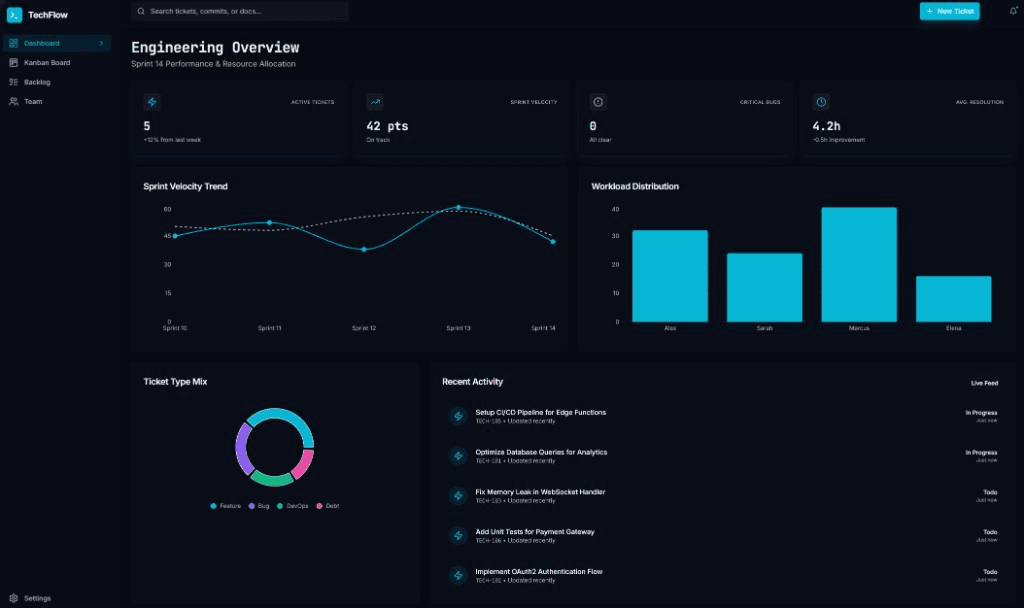
For an MVP, forget vanity metrics (visitor count, followers). Focus on two fundamental indicators. Activation: what percentage of signed-up users complete your product's key action? Aim for above 40%. Retention: among those who activated, how many return within 7 days? Once the product becomes a real SaaS with subscriptions, add revenue metrics: MRR (Monthly Recurring Revenue) measures your recurring income, churn rate indicates how many customers you lose each month, it's often the silent SaaS killer, and the LTV/CAC ratio (Lifetime Value / Customer Acquisition Cost) determines whether your model is viable: aim for a ratio above 3.
Recommended tracking dashboard
- Signup → Activation (key action completed): target > 40%.
- Activation → Day-7 retention: target > 20% at MVP stage.
- MRR / ARR and churn rate from your first subscribers on, target churn < 5% for B2B SaaS.
- NPS or open-ended satisfaction question after first session.
- Number of spontaneous qualitative feedback (emails, messages).
User onboarding: the first 5 minutes
If a new signup doesn't understand your product's value within the first 5 minutes, they'll leave and probably never come back. Design a guided onboarding that takes the user straight to their first 'aha moment.' Minimize setup steps, pre-fill data when possible, and use tooltips or a wizard to guide without overwhelming.
Good onboarding checklist
- Time from signup to first value action is under 2 minutes.
- A welcome email is sent immediately with a link to the key action.
- The first screen after login guides toward action, not settings.
- An onboarding email sequence (D+1, D+3, D+7) accompanies the user.
Building a compelling investor demo
Early-stage investors don't fund ideas, they fund evidence of traction. A navigable MVP is infinitely more convincing than a 40-slide deck. Prepare a 3-minute demo walkthrough that shows: the problem (in one sentence), the solution (in action), and early signals (real metrics). Rehearse until it's seamless.
Your MVP as a pitch deck companion
Your pitch deck presents the vision; your MVP proves it. Structure your presentation to alternate between slides and live demo. Start with the problem and market (slides), then show your solution in action (MVP), then return to slides for traction, team, and the ask.
Getting one paying customer before any optimization
The first paying customer is the only thing that proves you have a real product rather than a project. Until then, do not optimize, do not refactor, do not add features. Reach out personally to ten waitlist signups and ask them to try the product. Walk three of them through it. Ask them to pay $1 if it provides any value, what matters is the transaction itself, not the amount.
From MVP to V1, then to public launch
The transition from MVP to V1 isn't about features, it's about signal. You're ready when: (1) your core hypothesis is validated by data, (2) you've identified a clear, engaged user segment, (3) feature requests converge toward the same need. At that point, start structuring: more robust architecture, automated tests, a consistent design system, a database ready to handle more volume, a paginated and cached API. On the product side, identify the features that drive retention and double down on them before adding new ones. Use your AI builder to prototype new features before integrating them into the V1 codebase.
The launch day marketing checklist
- Product page finalized with a demo or presentation video.
- Announcement on Product Hunt, Hacker News, IndieHackers, or relevant communities.
- Launch email to your waitlist with a clear CTA and a launch offer.
- Posts on LinkedIn, Twitter/X, and specialized forums, tailored to each audience.
- A blog post explaining the problem you solve and your approach.
- Follow-up plan: re-engage at D+1, D+3, D+7 for signups who haven't activated.
After launch: the first 90 days
Launch isn't the finish line, it's the real starting point. The first 90 days post-launch are critical. Focus on three things: (1) improving activation, every percentage point gained compounds over time, (2) reducing churn, identify why people leave and fix the root causes, (3) finding your first 10 paying customers and understanding exactly why they pay. Those first 10 customers are your compass: everything you build next should serve to find more people like them.
What AI handles well, and what it doesn't?
- Handled well: scaffolding, CRUD pages, forms, dashboards, auth flows, Stripe Checkout, basic emails, simple workflows.
- Handled decently with care: complex business logic, multi-tenant data models, role-based access, scheduled jobs.
- Handled poorly without you: domain-specific algorithms, weird edge cases in data, hairy integrations with legacy APIs.
- Not handled: real architecture decisions, security hardening for regulated industries, performance tuning at scale.
Cost reality check for building and launching with AI
A solo founder who builds an MVP and then a SaaS with AI typically spends between 50 and 200 USD per month before getting to revenue. The breakdown: an AI builder subscription (Cadrant, Lovable or Bolt: ~$30–100), Supabase (free to start, ~$25 when you grow), Vercel (free hobby tier, ~$20 pro), Stripe (free, takes a percentage of revenue), Resend or Postmark for email (~$15–20), and a domain (~$12/year). Compare that with the 50,000+ USD a traditional engineering team costs over the same period; without AI assistance, expect 6 to 9 months of development for a full launch.
Realistic timeline: from idea to launched SaaS
With an AI app builder, a solo founder can reach a testable MVP in 2 to 4 weeks: Week 1, user research and hypothesis formulation. Week 2, building the landing page and minimal flow. Week 3, launch to an initial group (50–100 people) and data collection. Week 4, analysis, iterations, and decision to pivot or continue. If the signal is there, plan for 2 more months to turn that MVP into a publicly launched SaaS: weeks 5–6 for full authentication, Stripe integration and onboarding; weeks 7–8 for marketing preparation and a private beta with 20–50 users; weeks 9–10 for post-beta iterations; weeks 11–12 for public launch. That's about 3 months from concept to live product.
When to bring in a developer or an engineering team?
The short answer: as late as possible during the MVP stage. As long as you're exploring hypotheses, an AI builder's velocity outperforms a traditional development team. Bring in a CTO or senior developer when one of these is true: (1) you've validated initial product-market fit and the product is making revenue you need to harden for scale, (2) technical needs exceed what a no-code/AI tool can offer (critical performance, complex integrations, regulatory compliance), (3) you hit a problem the AI can't solve after several serious attempts, (4) you enter regulated territory (healthcare, finance, public sector), or (5) you're preparing a fundraise that requires a credible technical roadmap. The good news: a developer joining an AI-built codebase finds a modern, familiar stack, not a tangled custom mess. Until then, every dollar spent on custom development is a dollar not spent on validation.
The most common founder mistakes
According to CB Insights' analysis of startup failures, the top reason startups fail is building something the market doesn't need. A disciplined MVP approach directly addresses this risk.
- Building too much, too early: adding 'just in case' features, or spending 6 months without any user feedback, instead of testing a specific hypothesis.
- Ignoring negative signals: cherry-picking positive feedback and dismissing friction, or ignoring churn once you have your first subscribers.
- Technical perfectionism: choosing a complex stack, or refactoring the AI's code prematurely, for a product whose very existence isn't validated.
- No metrics, or pricing out of fear: launching without any tracking, or undervaluing your product out of lack of confidence, which attracts the wrong customers.
- Targeting too broadly, with no differentiation: trying to please everyone instead of delighting a micro-segment; 'like Notion but better' is not a positioning.
- Neglecting auth and security, or not owning your code: retrofitting security later is painful; being locked into a tool you don't control is just as bad.
- Underestimating marketing: a great product without distribution dies in silence, waiting for the perfect moment to launch amounts to the same thing.
Real-world MVP success stories
Dropbox validated its concept with a simple demo video, not a single line of cloud storage code. Buffer launched with a two-screen landing page: pricing + signup form. Zappos photographed shoes in stores and listed them online with no inventory. The common thread? Each tested a specific hypothesis with minimum effort, a pattern Paul Graham has written about extensively. Today, AI builders let you go further and deliver a genuinely usable product, not just a facade, while keeping that same agility.
Checklist before launching your MVP
- Your core hypothesis is stated in one testable sentence.
- You've identified a precise user segment (not 'everyone').
- The product flow focuses on a single key action.
- Minimal analytics tracking is in place (activation, retention).
- You have a list of 10–20 early adopters ready to test.
- A feedback loop is planned (form, interview, NPS).
- Your landing page is live with a clear CTA, and Stripe Checkout is already wired up.
- You've defined a quantitative success criterion to decide next steps.
Conclusion: the MVP is a mindset
Building an MVP, then turning it into a launched SaaS, isn't just a technique or a tool, it's a founder discipline. Embracing imperfection, seeking truth over validation, wiring up money early, and moving fast even in uncertainty. The rest, curiosity, rigor, resilience, is your part of the deal. Launch, listen, improve, repeat.