A tradesman website is not judged on how pretty it looks, but on how many qualified enquiries it produces each month. The scenario is almost always the same: someone types "carpenter London" or "electrician Manchester" into their phone, often while standing in the room that needs the work. They open two or three results, check quickly whether the trade covers their postcode, whether they are available and whether they have done this kind of job before, then they ring whoever looks most trustworthy.
This guide is for carpenters, electricians, painters and decorators, bricklayers, tilers and plasterers who want to turn their online presence into a steady flow of work.

Why a tradesman website changes your enquiry flow?
According to Google, 46% of searches have local intent, and 76% of those searches result in a visit or contact within 24 hours. Word of mouth is still the main source of work for most trades, and that will not change. But referrals now run through the internet before they land. When a neighbour recommends you, the person types your name into Google to check that you exist and that you cover their area. A website does not replace the recommendation, it confirms and amplifies it.
The second effect is more direct. A well built site makes you visible for searches you currently miss entirely: "engineered oak flooring fitted Islington", "consumer unit upgrade Manchester". These long tail queries bring precise, better prepared enquiries and face far less competition than generic keywords.
The page structure of a tradesman website that converts
Six to twelve pages is plenty. The classic mistake is cramming everything onto one endless homepage: you lose the ability to rank for distinct queries and the page becomes hard to read.
What a visitor wants to see in ten seconds?
The top of your homepage has to answer five questions without any scrolling. If one answer is missing, the visitor goes back to the results page and opens your competitor.
- The trade and speciality, stated plainly: "Joiner and fitted furniture maker, bespoke installations".
- The real service area, with the main towns or boroughs and a radius in miles.
- An indicative callback and start time, rather than silence.
- Proof of credibility: years trading, public liability insurance, trade qualifications, average review score.
- A price range, even a wide one, to set expectations before the call.
- Immediate contact: a tap-to-call number at the top of the page and a quote request button.
The homepage
Shop window and signpost. A clear headline, your service area, three to five services each linking to their own page, a selection of recent jobs, two reviews and a contact block. It does not need to be long, it needs to be decisive.
One page per service
This is the most underused lever there is. Create a page for every service you genuinely sell: floor fitting, window replacement, rendering, bathroom tiling. Describe how the job runs, typical duration, materials, a price range and two illustrated examples. Each one is another door into your site from search.
The service area page
List the towns, boroughs and postcodes you cover, with a simple map and your travel times. Duplicating the same text and swapping the town name adds nothing and can work against you.
Recent work
A portfolio sorted by job type, giving the context, duration and materials for each project. This is the page serious prospects read, the ones with a real budget who compare workmanship rather than price alone.
Customer reviews
Group your feedback and name the job type and the area. "Six sash windows replaced in Chorlton, finished in three days" is far more persuasive than an anonymous "Great tradesman".
Quote and contact page
A short form, a tap-to-call number, opening hours and one sentence explaining what happens after they hit send. Ask only for what you need: name, phone, postcode, type of job, optional photo. Every extra field costs you enquiries.
Job photos: your strongest sales argument
Photograph the starting state before you begin, every single time. Without that shot there is no before and after, and before and after is the format that generates the most enquiries. Shoot from the same spot at the same height so the comparison actually reads.
Write a useful caption rather than a decorative title: type of work, area, duration, one technical detail. "Solid oak floor restored in a Victorian terrace in Didsbury, four days including sanding and sealing" serves the visitor, the search engine and the AI assistants reading your page.
Watch image weight. Uncompressed phone photos run to several megabytes each and make the page unusable on a patchy mobile connection. Resize, export in a modern format, enable lazy loading and write descriptive alt text.
Quotes and pricing: set expectations without trapping yourself
Many trades refuse to publish any price. Silence has a cost though: calls from people whose budget bears no relation to your work, and evenings spent quoting jobs that will never land. Publish ranges clearly labelled as indicative, and name the variables.
- A ballpark figure per relevant unit: per square metre, per linear metre, per opening, per day on site.
- What is included and what is not: materials, removal of the existing installation, waste disposal, making good.
- Your travel policy: free within a set radius, charged beyond it.
- Any surcharges for urgent call outs, upper floors without a lift or restricted access.
- Avoid promising a fixed price online or a guaranteed date before you have seen the job.
Local SEO: showing up when someone searches nearby
Google Business Profile and NAP consistency
Your business profile is often the first point of contact, before your website. Fill in the primary category, service area, real opening hours and photos of recent jobs. Then keep your NAP consistent: name, address and phone number identical across your site, your profile and any directories. An address written three different ways muddies the location signal.
Town pages and long tail intent
Cross your services with your areas: "kitchen fitting in Stockport", "external rendering in Camden", but only where you have genuine material. Also target queries that describe a problem rather than a trade, such as "crack in load bearing wall what to do". Lower volume, better qualified contacts.
Reviews and structured data
Ask for a review at the end of every job that went well, with a direct link sent by text, and reply factually. Add LocalBusiness structured data in JSON-LD on your homepage and contact page, and Service data on each service page.
Mobile performance and technical SEO
Almost all of your visitors arrive on a phone. Design mobile first and check on a real handset. Core Web Vitals measure loading speed, responsiveness and visual stability: a page that jumps while loading makes people miss the call button.
- A tap-to-call number in the header of every page, repeated in the footer.
- A form with four or five fields at most, using the right mobile keyboard for each field.
- Tap targets large enough and spaced enough to hit with a thumb.
- Compressed images with reserved dimensions so the layout does not shift.
- Sufficient colour contrast, alt text on images, keyboard usable navigation.
Getting cited by AI answer engines
A growing share of searches now ends inside a conversational assistant rather than on a results page. To be quoted, give factual material: plain, specific statements about what you do, where and on what terms. A structured FAQ, one question per heading with a complete answer underneath, lends itself particularly well to that kind of extraction. Consistent business information matters even more here than in classic SEO: a model that finds three different versions of your phone number will cite none of them.
Seasonality, availability and subcontracting
Trade work follows strong seasonal cycles: roofing and rendering in spring and summer, insulation and external joinery before winter, interior refurbishment in the quiet months. Publish your seasonal pages several months before the search peak, so Google has time to index and rank them.
Be honest about availability. A banner reading "Booked until mid September" avoids disappointment and attracts customers who plan ahead. If you subcontract the trades you do not cover, say so: many homeowners want a single point of contact who can coordinate several trades, and that is a selling point in itself.
Insurance, accreditations and business details
Trust is built on verifiable details: your legal structure, company registration number, VAT status where applicable, public liability insurance and any workmanship guarantee you offer. List your trade qualifications, scheme memberships and manufacturer accreditations where you hold them, since some customers specifically look for them.
Include the legal pages people expect: privacy policy, terms and conditions, and your registered business details. Requirements differ by country and by trade and they change over time, so check what applies to your situation with your trade body or your accountant rather than copying the wording from a competitor with a different legal setup.
Measuring what actually matters
Visitor numbers are a secondary metric. What counts is incoming enquiries and their quality.
- Track taps on the phone number as a conversion in their own right.
- Log form submissions and quote requests, noting the area and the service requested.
- Record how many quotes turn into jobs, broken down by service type.
- Use Google Search Console to see which queries bring visits and which show you without clicks.
- Watch your business profile stats: calls, direction requests, clicks through to the site.
Get into the habit of asking on the phone how the customer found you. That ten second question gives you a more reliable reading than any dashboard.
Building the site with Cadrant, without coding
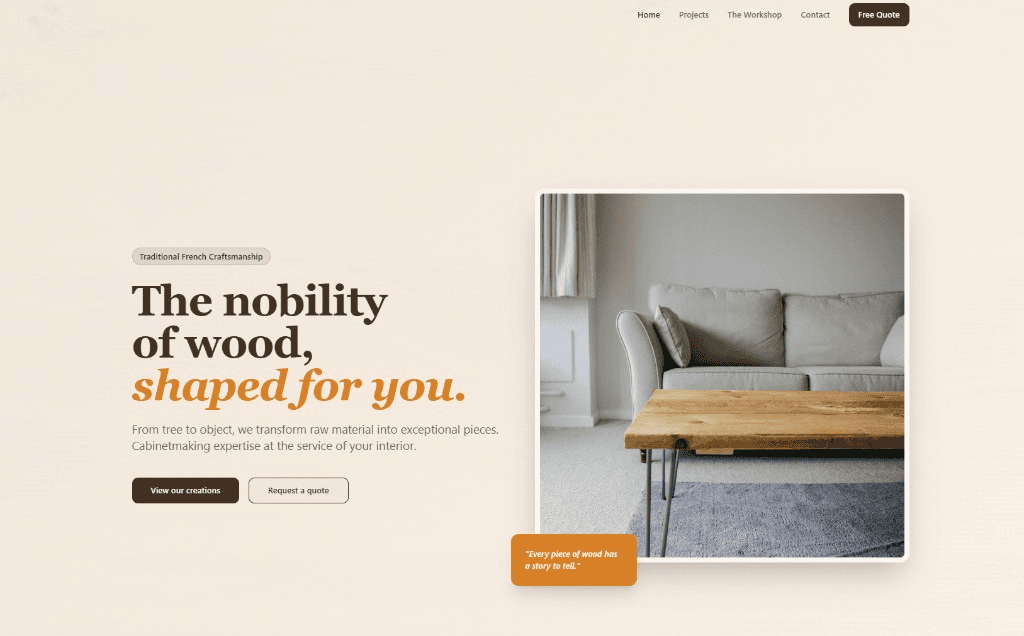
None of this requires technical skills. With Cadrant you describe your trade, your services and your service area in plain language, and the platform generates the matching pages, which you then refine through conversation. The practical benefit is being able to edit the site yourself, in the evening, without waiting on an agency to change a price range or add a few job photos. A site where recent work keeps appearing ranks better than one frozen since three years ago.
Where to start?
Do not try to produce everything at once. Start with a homepage that answers the five ten second questions, a contact page with a tap-to-call number, and a fully completed Google Business Profile. Then add one service page a month, beginning with your most profitable work, and document every finished job with two photos and a short caption.