Relying only on ride-hailing platforms means accepting a commission on every job and never owning your customer base. The passenger you drive faultlessly on Monday opens the app on Friday and gets someone else. A private driver website changes that equation: it lets you take enquiries directly, bring good clients back, and open corporate accounts that consumer apps serve poorly. This guide covers the pages to build, the quote and booking journey, the local search work that genuinely pays off in this trade, and the regulatory caution the sector demands.

Why direct booking changes your profitability?
According to Google, 46% of searches have local intent, and 76% of those searches result in a visit or contact within 24 hours. The gap between a platform job and a job from your own site is not only the commission withheld. It is repetition. A direct client calls you again, recommends you, and accepts a booking scheduled well in advance that saves you hours of waiting. The arithmetic is simple: a handful of regulars and two or three corporate accounts stabilise turnover far better than a volume of one-off jobs you have no control over.
- Margin protected: no intermediary commission on jobs booked through your own site.
- Repeat clients: you hold the contact details, so you can follow up and build loyalty.
- Corporate accounts: monthly invoicing, framework agreement, a single point of contact, impossible through a consumer app.
- Planning: advance bookings fill the quiet hours and cut empty mileage.
- Control of your image: your fleet, your service standard and your prices presented the way you choose.
What the client wants to know before booking?
Someone booking a chauffeur for a six in the morning flight is not buying a journey, they are buying the certainty of arriving. Your site must remove the six uncertainties that stall a booking, ideally before the form even appears.
- The route and the price: exactly what central London to Heathrow costs, all inclusive.
- The vehicle: class, number of seats, standard of finish, cleanliness and comfort.
- Punctuality: your commitment if things run late, your safety margin, how you track the job.
- Luggage: how many cases genuinely fit, child seats, bulky equipment, pets.
- Payment: card online, prepayment, on board, VAT invoice for business travellers.
- Cancellation: free notice period, any charges, what happens if the flight is cancelled.
The page architecture of a private driver website
Home
An explicit geographic headline, a quote module visible without scrolling, and three concrete arguments: punctuality, recent vehicles, price known in advance. The phone number must be tappable at the top of the screen on mobile.
Services
One page per service, not a single list: airport transfer, rail station transfer, hourly hire, long distance, events and weddings, corporate travel. Each deserves its own title, its own indicative price and its own call to action, because each matches a different search.
Fleet
Real photographs of your cars, class, passenger capacity, luggage capacity, on-board amenities. This page reassures heavily on a premium service and prevents unpleasant surprises on transfer day.
Prices and quotes
Publish fixed fares for the most requested routes and a clear rate card for hourly hire. State what is included: waiting time, tolls, luggage, child seat. Price transparency is both a widespread expectation in the sector and your strongest argument against fluctuating app pricing.
Booking
A short form, instant confirmation, and a summary emailed with your direct number.
About
Your experience, your operating licence, your insurance, the languages you speak. An identifiable driver inspires more confidence than an anonymous brand.
Contact
Phone, email, instant messaging if you genuinely answer it, hours of availability and the area you cover.
Quotes and booking: the heart of the site
The quote module is what separates a useful site from a digital brochure. Ask for pickup point, destination, date, time, number of passengers and bags, then show an immediate estimate. Even a range calculated from predefined fares beats a promise to get back to them. Follow straight on with booking and instant confirmation, then an automatic reminder the day before. For airport work, include the flight number in the form: it lets you monitor delays and adjust the pickup time without calling the client. Card prepayment sharply reduces last-minute cancellations; failing that, a card authorisation or a deposit plays a similar role.
Airport and station transfers: your most profitable pages
These pages earn the most because the search intent is extremely high: someone typing a specific route to an airport books within minutes. Create one page per route you actually serve, with the exact place names, the average journey time by time of day, the fixed fare, the included waiting time and the meeting point at the terminal. A page for central London to Gatwick and a separate one for Manchester Airport beat a generic airport transfers page. Spell out the meet-and-greet protocol: name board in arrivals, help with luggage, procedure if the flight is delayed or diverted. Those operational details are exactly what the traveller is looking for.
Business clients and corporate accounts
Corporate travel is the segment platforms serve worst, which makes it your best opportunity. A company is not hunting the lowest fare: it wants a reliable driver, clean invoicing and complete discretion. Build a dedicated page that answers those specific expectations.
- Consolidated monthly invoicing with VAT details and an internal purchase order reference.
- Receipts formatted for expense claims, sent automatically after each journey.
- Framework agreement with negotiated rates for recurring runs between office, airport and client sites.
- Discretion and confidentiality: a sensitive point for executives, worth stating plainly.
- Hourly or half-day hire for client visits and roadshows.
- A single reachable contact with a stated response time for urgent requests.
Local SEO for a private driver website
Your visibility rests on very precise geographic queries. Start with a complete, verified Google Business Profile: exact category, service area, phone number, link to your booking page, photographs of your vehicles. Reviews carry serious weight in this trade; ask for them systematically after a successful transfer, with a short message sent the same evening. Then build one page per city served, London, Manchester, Birmingham, and one page per major route. Aim at long-tail intent rather than the generic term: a query naming a specific station and destination converts far better than a highly contested single keyword. Finally, add LocalBusiness structured data in JSON-LD with your trading name, service area, phone number and hours.
Technical SEO and performance
- Strict mobile-first: almost every last-minute booking happens on a phone, sometimes on a poor connection.
- Solid Core Web Vitals: compressed vehicle photos, no heavy carousel, fast loading on mobile data.
- Click-to-call button fixed to the bottom of the screen on mobile, present on every page.
- A messaging link only if you genuinely reply within the minute; otherwise leave it out.
- Accessibility: sufficient contrast, labelled form fields, keyboard navigation.
- Internal linking: every city page points to the matching routes and to the quote form.
Being cited by AI answer engines
A growing number of travellers put their question to an assistant rather than a classic search engine: what a transfer between a given city and a given airport costs, who covers that route overnight. To appear in those answers, your content must be factual and extractable. State your service areas, operating hours, vehicle classes and fares as clear ranges. A structured FAQ, self-contained sentences and place names written out in full give verifiable material to cite. Vague copy built on superlatives offers nothing to pick up.
Regulatory framework: stay accurate and cautious
Carrying passengers for hire and reward is a regulated activity in most countries, and the rules differ noticeably from one territory to another. Without going into the detail of any statute, several principles recur widely and should shape what you publish. An operating licence or authorisation is generally required, together with a driver licence or badge issued by the relevant authority. Pre-booking is mandatory in many countries for this type of service, and picking up passengers hailing in the street or waiting on a taxi rank is prohibited there. Insurance specifically covering the carriage of passengers is essential and distinct from an ordinary motor policy. Finally, fare transparency, a price known or determinable before the journey, with a receipt provided, is a frequent regulatory expectation as much as good commercial practice. So state your status and your authorisations accurately, without quoting legal provisions you have not verified, and have your position confirmed by a legal professional or your trade body.
Measuring the direct share
The only figure that really matters over time is the share of turnover you take directly versus through platforms. Track it monthly, alongside a few simple measures: bookings placed through the site, quote requests received, calls generated by the mobile button, conversion rate from quote sent to job confirmed, and the number of clients who have booked more than once. Google Search Console will show which routes bring visitors and which sit on the second page, those are the pages to write next. A monthly table of ten lines is plenty.
Building your private driver website with Cadrant
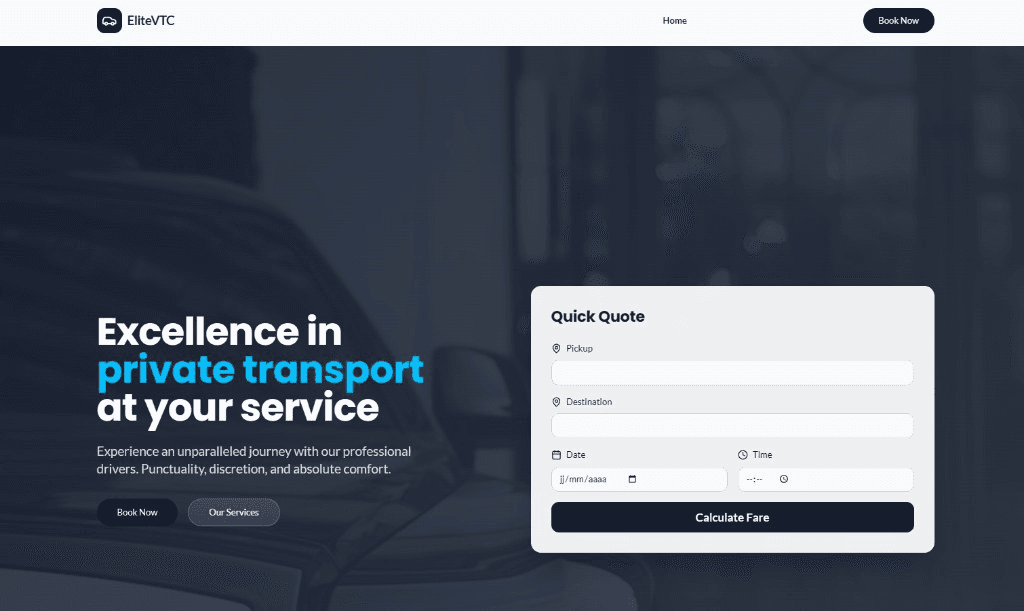
You do not need a developer to launch a direct booking site. With Cadrant you describe the pages you want in plain language, home, services, fleet, fares, quotes, booking, and the platform generates a structured web application you refine through conversation. You can then add a corporate client area, a journey history or automated invoicing step by step, without starting again. Preview on mobile, tighten the wording, publish.